Introduction
Remember the first time you used ChatGPT? Watching a cursor blink and instantly output a functional block of code or a marketing strategy felt like pure magic.
But a few years into the generative AI boom, the cracks in that experience are showing.
We’ve essentially become professional babysitters for algorithms. We spend our days endlessly tweaking prompts, copying and pasting data between tabs, and steering chatbots when they lose the plot. We are treating AI like a smart calculator when we actually need a colleague.
That is why the software industry is shifting from AI tools that respond to commands toward systems that can independently execute work. We are moving past the era of static, reactive chatbots.
We are entering the age of Agentic AI.
From Text Generators to Autonomous Workers
To understand this shift, look at how we currently interact with AI.
Traditional generative AI is entirely reactive. It waits for a command, processes the request, and stops.
If you want to launch a campaign, you are the connective tissue. You ask the AI for ideas, copy those ideas into a new prompt for a strategy, manually email your team, and log into your project software to assign tasks.
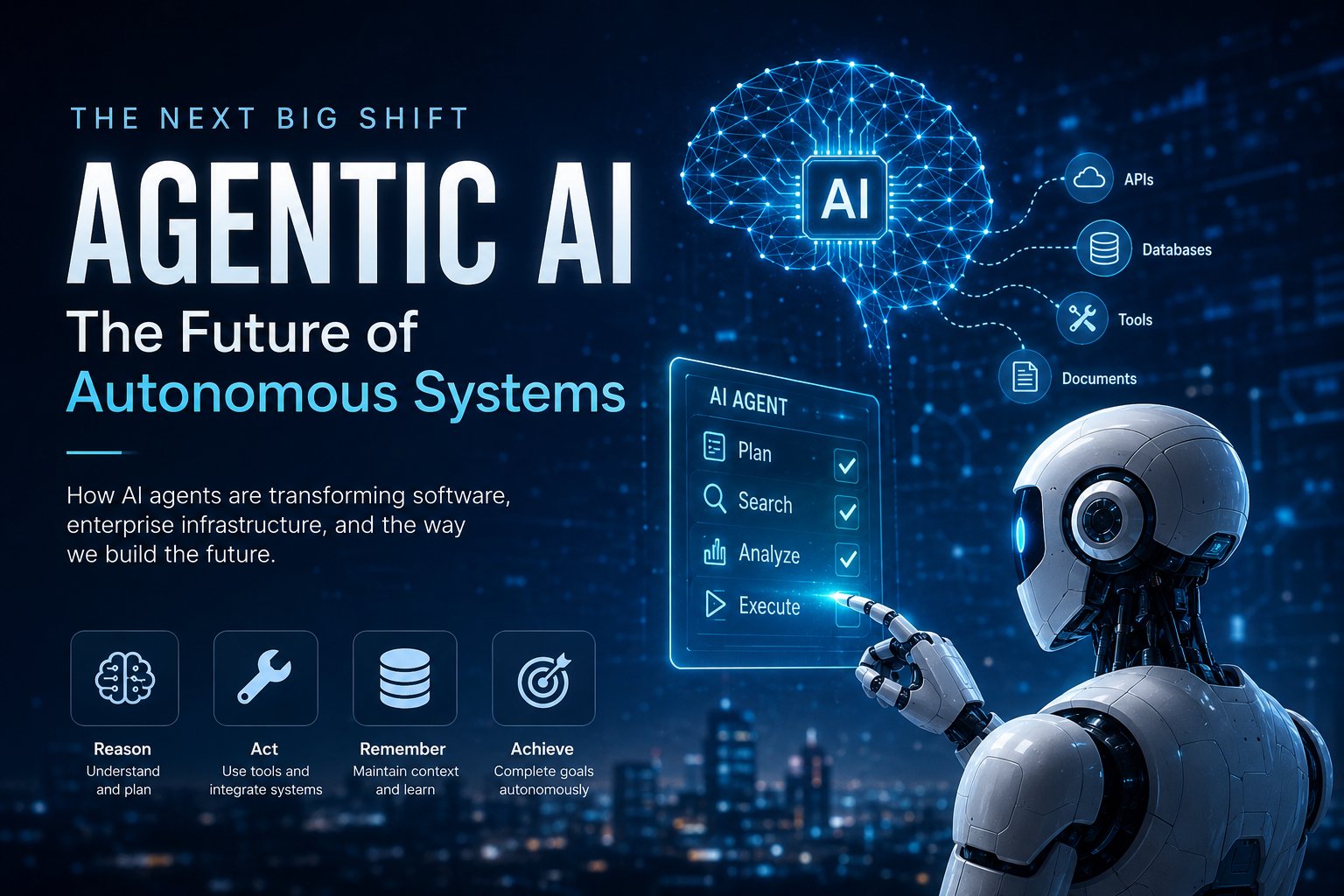
Agentic AI changes the equation from “write this for me” to “do this for me.”
It doesn't wait for step-by-step instructions. You give it a high-level goal, and it takes over.
It plans. Executes. Adapts.
If you tell an AI agent to onboard a new client, it breaks that goal into micro-tasks. It securely connects to your internal software, drafts the onboarding emails, updates your CRM, and schedules the kickoff meeting. If an API fails or a meeting slot is taken, it self-corrects and finds an alternative path without asking you for help.
The New Enterprise Workforce
This isn't just about personal productivity. It is fundamentally altering business operations. Companies no longer want to buy software that requires massive human overhead to manage. They want digital workers that scale.
Look at how this is already playing out:
- Software Development: Instead of basic code completion tools, autonomous agents now ingest entire repositories. They identify bugs, write patches, run test suites, and submit pull requests independently.
- Customer Operations: Support is moving past rigid decision-tree bots. Agentic systems can securely access a customer’s billing history, diagnose an issue, issue a refund within company policy, and update records without human intervention.
- Data Analytics: Instead of a human manually cleaning spreadsheets, agents continuously monitor live data pipelines. They detect anomalies, cross-reference them with market trends, and alert stakeholders before a human even notices a variance.
The Autonomy Dilemma: Trust and Safeguards
With great capability comes a massive governance headache. Shifting from a tool that suggests actions to a system that executes them introduces serious risks.
Security, data privacy, and unintended logic errors are real concerns. If an autonomous agent misinterprets a complex corporate policy, the financial or reputational damage could be severe.
Because of this, the rise of Agentic AI isn’t a hands-off transition. It requires a robust "Human-in-the-Loop" architecture.
The future of work isn't about letting AI run wild. It’s about humans stepping into the role of managers—setting the guardrails, defining the boundaries, and acting as the final approval mechanism for high-stakes decisions.
A Grounded Look Forward
When cloud computing first emerged, it didn’t just change where we stored files; it completely rewrote how software was built and consumed. Agentic AI is poised to do the exact same thing to human labor.
Software is no longer a passive icon sitting on your desktop. It is becoming an active digital teammate.
The companies and professionals that learn to work alongside AI agents today will operate on an entirely different level five years from now. The shift is no longer theoretical—and the groundwork is being laid today.